 EN
EN
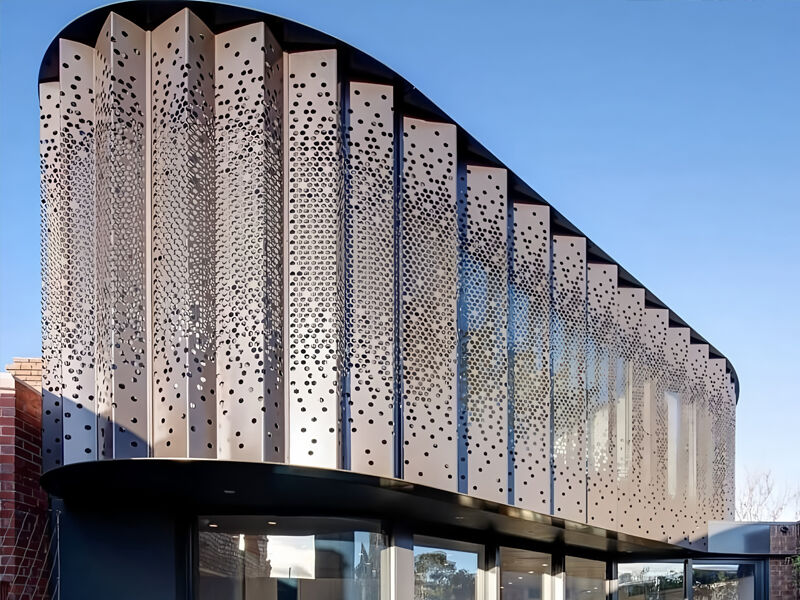
What Is a Perforated Aluminum Facade?
A perforated aluminum facade is an architectural cladding system composed of aluminum sheets mechanically punched with patterned openings. These panels serve as an outer building layer, balancing functional performance with striking visual impact. The holes—which vary in shape (round, square, slot), size, and density—enable controlled light penetration, ventilation, and solar shading while maintaining structural integrity. Aluminum’s inherent lightweight properties (roughly one-third the weight of steel) reduce load stress on substructures, simplify installation, and enhance seismic resilience. Its corrosion resistance and capacity for powder coating or anodizing ensure longevity in diverse climates without demanding intensive maintenance. Architects leverage perforated facades to create dynamic exteriors, where patterns transform sunlight into evolving shadow plays across surfaces—turning static walls into responsive design elements that interact meaningfully with environmental conditions.
Key Performance Benefits of Perforated Aluminum Facades
Solar Shading and Energy Efficiency
A perforated aluminum facade functions as a dynamic solar shading device. By strategically blocking direct sunlight while transmitting diffused daylight, it reduces solar heat gain and can cut cooling energy use by up to 30%, lowering HVAC demand and improving occupant comfort. Daylight harvesting further decreases reliance on artificial lighting. When integrated as a rainscreen or double-skin element, the perforated layer also contributes to thermal buffering—enhancing the building envelope’s overall insulation performance without compromising breathability.
Ventilation, Acoustics, and Weather Resistance
The engineered openings support natural cross-ventilation, helping regulate interior temperatures and reducing mechanical ventilation loads—particularly valuable in mixed-mode or low-energy buildings. Simultaneously, the panel surface acts as an effective acoustic absorber, attenuating external noise and improving indoor sound quality. Despite the apertures, properly designed perforated aluminum systems maintain excellent weather resistance: they shed rain, resist wind-driven moisture intrusion, and withstand UV exposure and coastal salinity. Their lightweight nature eases structural demands, while corrosion-resistant alloys and durable finishes ensure decades of reliable performance in demanding environments.
Design Flexibility and Aesthetic Impact
Perforated aluminum facades offer architects unparalleled design freedom, enabling unique visual statements while maintaining functional performance. This adaptability stems from the material’s inherent properties and advanced manufacturing techniques—including CNC punching, laser cutting, and digital pattern programming.
Pattern Customization, Scale, and Visual Rhythm
Manufacturers can produce virtually any hole pattern—geometric, organic, or gradient—with precise control over aperture size (1mm–50mm) and open area ratio (10%–70%). This precision allows designers to calibrate light transmission, airflow, and shading performance while crafting dynamic visual rhythms across façade surfaces. Varying perforation density across panels introduces movement, depth, and texture—transforming flat expanses into layered, sculptural compositions. Standard panel dimensions (e.g., 1200mm × 2400mm) support efficient fabrication and large-scale installations without sacrificing design continuity.
Integration with Building Identity and Context
These facades strengthen architectural narratives by embedding regional motifs, cultural references, or corporate identity directly into the cladding. A university campus might incorporate fractal patterns symbolizing knowledge networks; a coastal office could feature wave-inspired perforations echoing its setting. Finish options—including anodized, PVDF-coated, or woodgrain-laminated surfaces—allow seamless contextual harmonization with adjacent materials and urban fabric. As demonstrated in projects certified under LEED v4.1 and BREEAM New Construction, such intentional integration reflects both aesthetic sophistication and performance-driven design thinking.
Practical Considerations for Specification and Installation
Material Thickness, Perforation Ratio, and Substructure Compatibility
Selecting the correct material thickness and perforation ratio is critical to ensuring structural integrity, wind resistance, and long-term serviceability. Common thicknesses range from 1.5 mm to 3 mm—determined by panel span, exposure category, and local wind load requirements per ASCE 7-22. The perforation ratio—typically 20% to 50% open area—directly influences solar control, airflow, weight, and stiffness. Higher ratios increase daylight and ventilation but reduce panel rigidity; engineers must therefore coordinate closely with façade consultants to align perforation parameters with substructure capacity and attachment detailing. Aluminum alloys like 3003-H14 and 5005-H14 provide optimal formability, weldability, and corrosion resistance for exterior applications. Substructures—commonly aluminum or galvanized steel framing—must accommodate thermal expansion, drainage, and secure anchorage per ASTM E283 and E330 test protocols.
Maintenance, Durability, and Lifecycle Cost Analysis
Perforated aluminum facades require minimal maintenance: an annual or biannual wash-down with mild detergent and low-pressure water typically suffices to remove dust, pollutants, and organic buildup. High-performance finishes—especially PVDF-based coatings meeting AAMA 2605 standards—resist fading, chalking, and gloss loss for more than 20 years, even in high-UV or industrial environments. From a lifecycle perspective, higher perforation ratios may reduce initial material costs but can compromise shading efficacy—potentially increasing cooling loads and offsetting energy savings. Conversely, thicker panels with optimized ratios and premium coatings deliver superior durability, lower total cost of ownership, and consistent performance over a 30+ year service life—making them the preferred choice for institutional, healthcare, and high-performance commercial projects.
FAQ
What is a perforated aluminum facade used for?
It serves as an architectural cladding system that balances aesthetics with functionality, offering benefits like solar shading, ventilation, and energy efficiency.
How does a perforated aluminum facade improve energy efficiency?
The perforations block direct sunlight while allowing diffused daylight, reducing solar heat gain and the need for artificial lighting or cooling.
What are the customization options for perforated aluminum facades?
Design flexibility includes customizable hole patterns, varying aperture sizes, and a wide range of finishes (e.g., anodized, PVDF-coated, woodgrain).
What maintenance is required for these facades?
An annual or biannual wash with mild detergent and low-pressure water suffices to maintain them, thanks to their durable finishes.
What factors should be considered when specifying a perforated aluminum facade?
Important factors include material thickness, perforation ratio, substructure compatibility, thermal expansion, and drainage requirements.